Quick Answer
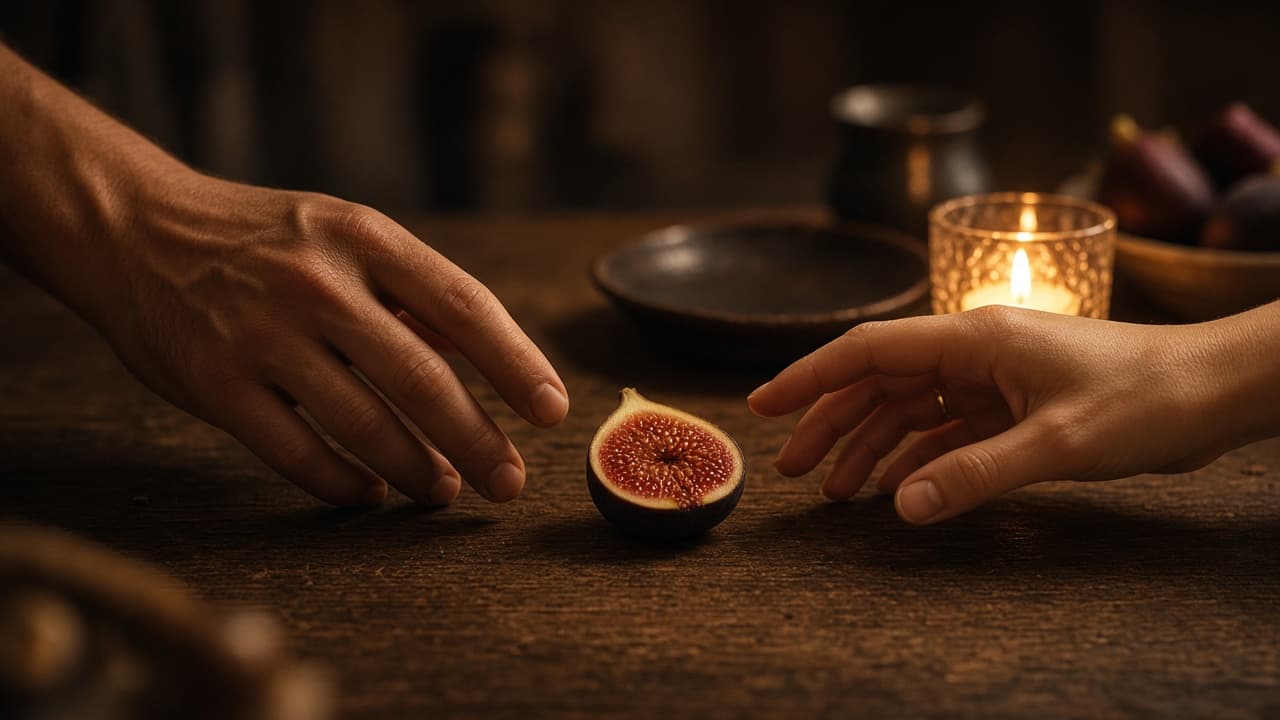
Sometimes a dream is about a house or a dog or a test, and desire is only the fuel. Sometimes desire is the plot: you chase, you taste, you are stopped at the last inch, you get what you wanted and it is wrong, you want in a way you will not admit by day. Those nights are reports on wanting itself. You do not have to act the dream. You do have to notice whether the hunger has a name, a prohibition, and a cost.
Chasing What Recedes
You almost reach it, a person, a mouth, a prize, a door, a flavour, and the geometry cheats. Distance is the device.
This is the rainbow-chase applied to appetite. The want is real. The arrival is structured not to happen. It maps onto goals that are being used as perpetual engines (the next body, the next job, the next hit of being chosen) and onto loves that are exciting because they cannot complete.
If you enjoyed the chase more than you suffered it, the unfinishedness may be the point, and daylight should get to know that. If you suffered, you may be exhausting yourself on a receding object when a stationary one would feed you.
Tasting, Touching, Almost
Contact happens and is partial: a kiss, a bite of food, a fabric, a voice. The dream is interested in the sample, not the meal.
Sampling can be wisdom, you are gathering data about a want. It can be a bind: you will allow yourself the almost and not the having, which is how some families and some religions teach desire. It can be a body fact about arousal and REM, which is allowed to be uninteresting as symbolism.
Whether the taste was good matters. A sour sample is information. A perfect sample you were then pulled away from is a different cruelty: you now know what you are missing.
Being Forbidden
A law, a third person, a locked room, a body that will not, a god, a camera. The want has an audience of no.
Forbiddenness is often the loudest character in the dream. The object might be interchangeable; the prohibition is not. Affairs in sleep, incestuous-feeling scenes that are actually about power, stolen prizes, food you must not eat: ask what rule is being staged. Some rules are protecting someone. Some rules are protecting a self-image. Some rules are leftovers from a house you do not live in.
Acting through the prohibition in the dream, and waking intact, is one of the psyche's safer laboratories. You found out something about the want without invoicing the real people. Use that. Do not turn it into a plan without a second, waking ethic.
Getting It | and the Aftermath
The plot completes. Sex, winning, swallowing, being chosen. Then: emptiness, panic, a transformed object, a witness, ordinary lighting.
Fulfilment dreams are underrated because people come to dictionaries in frustration. Getting the thing is data. If it was enough, you have a picture of a hunger that can end. If it immediately produced a new hunger, you are in a structure, not a shortage. If it produced shame, the rule arrived at dessert.
A desired person who became someone else at the moment of having is a particularly honest image: you were using a face. The want was for a function, safety, status, revenge, mother, crush as lifestyle, and the face could not hold it.
Have a Desire dream of your own?
Write what you remember and get a clear reading.
Wanting to Be Wanted
The desire is not toward an object. It is toward being the object: to be chosen, looked at, hungered for, picked out of a room. Recognition as appetite.
This sits near celebrity dreams and near invisible ones. You can want to want, and you can want to be wanted, and they are not the same night. If you staged yourself and nobody hungered, the wound is specific. If everybody hungered and you could not bear it, visibility has a cost you have not budgeted.
People who live as caretakers, parents, reliable ones, often get this dream when a buried wish to be the feast rather than the cook finally gets REM time. It is not childish. It is information about a diet of being useful.
Forbidden Because It Is Yours
A twist: the thing you must not want is a lawful life, rest, a body, money, a talent, being happy in a way your family did not. Internalised prohibition on your own good.
These dreams can look modest: a bed, a plate, a room, a person who is actually available. The drama is all in the stopping. If that is your pattern, the work is less about decoding a wild object and more about asking who benefits from you not taking the ordinary thing.
Guilt after a gentle desire dream is a clue. Save the heavy analysis for the heavy scenes. Here, the interpretation might be: you are allowed.
The Body as Weather
Arousal without a story, a heat, a search, REM's ordinary sexual physiology given a thin plot. Not every desire dream is a thesis.
Michael Schredl's research on erotic dream frequency shows wide individual variation and a real link to waking sexual interest, age, and attitude, not to prophecy. If you have been touching, watching, abstaining, pairing, or thinking, expect the night to copy. If you have not, the body still has a chemistry. You can let some nights be weather.
When the weather always uses the same person, then you have a repeating object and the rest of this page applies.
Psychological Meaning
Sigmund Freud's 1900 claim that dreams are wish-fulfilment is the unavoidable citation on a page about desire, and it is both too much and not enough. Too much: not every dream is a fulfilled wish, and later research did not spare that monopoly. Not enough: even Freud knew wishes arrive disguised because they conflict with other wishes and with internalised rules. A desire dream that shows the conflict, chase, prohibition, aftermath, is often more faithful than a dream that simply hands you the object.
Michael Schredl's 2011 review of factors influencing dream content (and his work on erotic dreams specifically) is the empirical counterweight. Waking concerns, including sexual and ambitious ones, show up in sleep with considerable continuity. People who are hungry dream of hunger. People who are trying not to be hungry dream of locked kitchens.
Hartmann would add that high-arousal emotion contextualizes in powerful, simple pictures. Wanting is high-arousal. A chase, a mouth, a locked door are simple pictures. You do not always need a third layer.
Read the dream as a report on a want: its object, its prohibition, its sample, its aftermath. Then decide, awake, with your actual ethics, whether the want has a form that can live in the day. The night is allowed to be ruder than you are.
When Wanting Is Every Night
Recurring desire dreams mean the hunger is not getting a waking life. Either it is being starved, or it is being fed in a way that cannot complete (the receding object), or it is being used as the only available intensity.
Starvation wants a lawful meal, conversation, sex you consent to, work that tastes like something, rest. The receding object wants you to notice that arrival is never the plan. Intensity-as-drug wants more ordinary feeling so that desire is not the only weather that counts.
If the dreams are compulsive, distressing, or attached to someone who cannot or should not be in them, get a human ally. Desire is not a crime. Being trapped in a night of wanting can still be a kind of suffering, and it is treatable as such.