Quick Answer
Dancing is the body agreeing to a timing, often with other bodies, often with eyes on it. Dreaming of dance usually tracks coordination: a relationship's rhythm, a group's pace, a public joy, a humiliation when the beat is lost. It sits next to [parties](/dreams/parties) and [weddings](/dreams/weddings) as social ritual, and next to [sex](/dreams/sex) when attunement is the subject, without being only those things. A person can dance from grief or from competence. Recover the music's speed, the partner if any, and whether you wanted to be seen.
Dancing with Joy, Alone or in a Crowd
The body knows. The room may be empty or full. Nobody needs to be impressed. You wake with the residue of pleasure.
Joyful dance is one of the cleaner good dreams. It reports access to a register that is not problem-solving: play, worship, relief, a body that will cooperate. People who have been living in their heads for months sometimes get this as a reminder that they have a trunk and legs.
If you were alone, the joy does not currently require a witness, which can be a healthy sign or a sign that you do not trust a room with your pleasure. If you were in a crowd that shared the beat, belonging is physical rather than verbal. Crying while dancing is not a contradiction; intensity often uses both. Do not rush to pathologise a happy dance. Let it be data that this channel still opens.
Losing the Beat, Wrong Steps, Frozen
Everyone else has it. You do not. Shoes stick. The count is 1-2-3 and you are on 4. People notice, or you think they do.
Lost-beat dreams are social-timing problems. A new job's pace. A friend group's humour. A family that talks over each other in a rhythm you never learned. A country you moved to. The dance floor is just the clearest picture of "I cannot get in time with these people."
If you kept trying, you still believe attunement is possible. If you left the floor, you are protecting dignity. If someone laughed, shame is in the plot; if someone slowed down for you, help exists. A body that would not move at all is closer to freeze than to bad dancing, anxiety's shutdown, or a refusal to perform.
This is not a talent forecast. People who dance well in daylight still have these when the waking "dance" is a meeting.
Dancing with a Specific Person
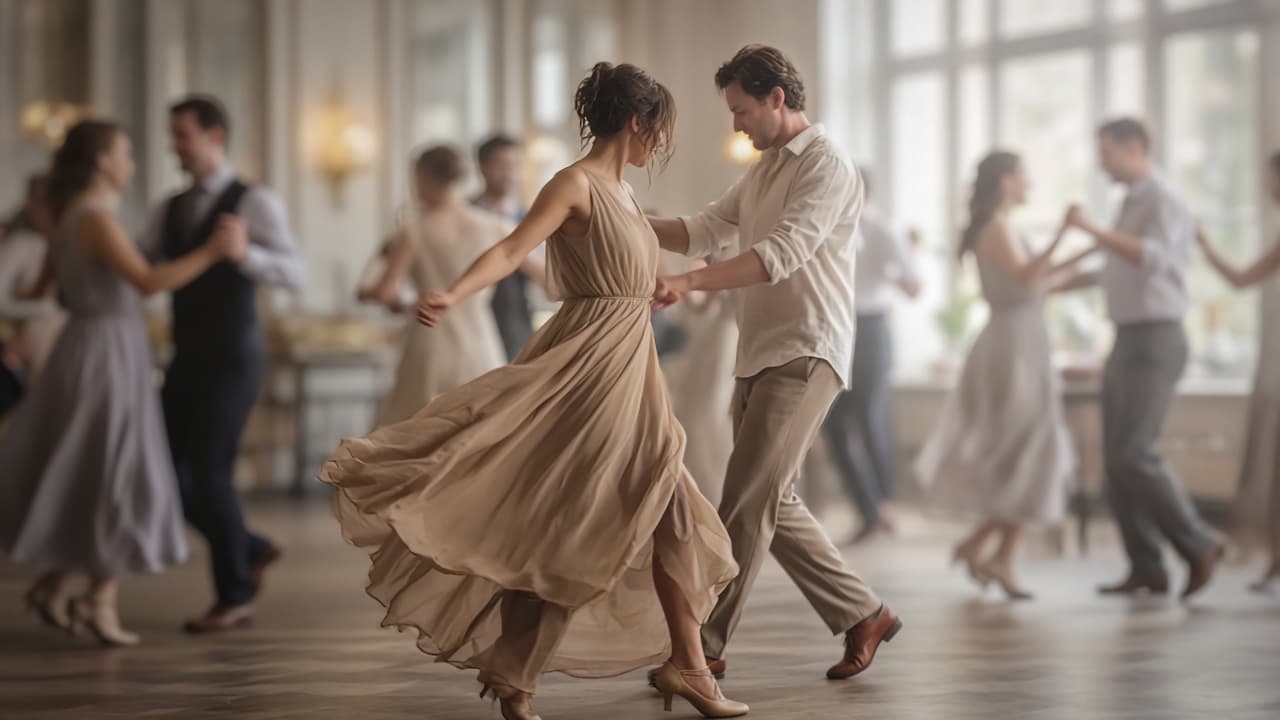
A hand on a back. Lead and follow. Faces close. The person may be a lover, a stranger, a parent, a colleague it would be unwise to name at work.
Partnered dance is relationship as timing. Who led is often the most honest line in the week. Being well led can be rest or a loss of authorship. Leading someone who will not follow is a management or parenting dream as much as a romantic one. Stepping on feet is ordinary friction made visible. Matching perfectly is rare and usually arrives as a wish or as a report of a week when things actually clicked.
If the person was dead, you are in memory's ballroom; the dance can be a visit without being a summons. If the person is someone you should not be close to, the dream is testing a chemistry. You do not have to act it out. You do have to admit the timing exists.
Intimate dancing that becomes sex is a continuum of attunement; abrupt cut-off is often a boundary asserting itself mid-scene.
Being Watched: Stage, Circle, Wedding Floor
A spotlight, a first dance, a circle that claps, a wedding that has decided you are the show.
Audiences turn dance into evaluation. That can be the point, you wanted to be seen as graceful, sexual, fun, competent. It can be the nightmare, you did not consent to be the entertainment.
A first dance at a wedding is a public bond in motion; disaster in that scene is fear of the bond being judged, not just the steps. A stage with choreography you have not learned is closer to an exam. A circle at a party is belonging-as-spectacle: the group is generating itself by watching you. If you enjoyed the eyes, hunger for visibility is live. If you wanted the floor to open, you are over-exposed in some waking room.
Have a Dancing dream of your own?
Write what you remember and get a clear reading.
Formal Dance, Folk Dance, or a Dance You "Should" Know
Waltz, ceilidh, a cultural form, a school dance from decades ago. Rules. A caller. Embarrassment if you are the one who never learned.
Codified dances are membership tests. Families, churches, nations, professions have steps. The dream puts you in the form to ask whether you have the training, the right, the willingness.
If you knew the dance and others did not, you may be carrying a tradition, or using it as status. If you were supposed to know it because of who you are, heritage, class, a partner's world, and you did not, the membership is incomplete. School dances that return in middle age are often rank-and-belonging files that never closed. A teacher or caller shouting counts is an authority who still owns the timing.
Dancing When You Should Not, or Cannot Stop
A funeral, an office, a hospital. Or a dance that continues after you want to sit down. The body will not obey the occasion, or will not stop.
Wrong-time dancing is affect that will not respect the social contract. Inappropriate joy, inappropriate sexuality, a grief that comes out as movement, mania, a refusal to be solemn. It can be liberation or a fear of being the person who cannot read a room.
Cannot-stop is a different problem: a role, a performance, a people-pleasing rhythm that has no off switch. Work that has become a dance you do in your sleep. A relationship that requires constant attunement. Sitting down in the dream, if you manage it, is a boundary. Being pulled back up is the system refusing the boundary.
No Music, or Dancing in Silence
Bodies moving. No soundtrack. Or music only you can hear.
Silence on a dance floor is a missing shared mood. The group is going through motions without the feeling that makes them make sense. Corporate away-days. Marriages that still have the steps. Churches that kept the liturgy and lost the heat.
If only you heard the music, you are on a private frequency, lonely, or ahead, or simply elsewhere. If you danced without needing sound, the body has its own timing; that can be a strong self. Trying to start the music and failing is a wish to restore atmosphere to a room that has become procedural.
Psychological Meaning
Dance is social cognition in the muscles. Deirdre Barrett, in The Committee of Sleep (2001), gathered evidence that dreaming often continues the day's problem-solving, including problems of performance, relationship, and creative timing. Dancers and athletes report rehearsal dreams; the rest of us rehearse the social dances we do not call dance. Barrett's larger point, the night committee keeps working on what the day left unfinished, fits a lost-beat dream before a wedding, a partner-dance dream during a negotiation, a joyful dance after a thaw.
You do not need to be a performer for the committee to use this imagery. Humans already describe teams, families, and flirtation as dancing. The dream makes the metaphor literal so the timing can be felt. That is more useful than a list that claims a waltz always means marriage.
Dancing dreams do not predict weddings, affairs, or talent. They report whether you are currently in time with someone, with a group, or with your own pleasure, and what happens when eyes are on that fact.
When Dancing Dreams Keep Returning
Repeating lost-beat dreams usually mean a social tempo is still unmatched; you can slow down a waking interaction on purpose and see whether anyone meets you. Repeating partner dances with the same person usually mean the relationship's timing is an open file. Repeating joyful dances may be the mind offering a medicine, more play, more music, more unproductive body.
If you hate dancing in waking life, the dream is still probably not about dance class. It is about coordination. And if a dance dream leaves you glad, protect a little of that gladness in the day. The committee does not only send warnings.