Quick Answer
Climbing is ascent you pay for with the body. Hands, feet, breath, the refusal of a lift. Dreaming of it usually tracks effortful progress: a career, a recovery, a reputation, a [mountain](/dreams/mountains) that is also a life. It is the verb that [ladders](/dreams/ladders) and cliffs share. Slipping, summiting, getting stuck, climbing a [wall](/dreams/walls) or a [tree](/dreams/trees) or a [house](/dreams/houses) that was not a route, those scenes decide whether the effort is a path, a trap, or a trespass. Recover the object. A rock face and a corporate glass wall are not the same climb.
A Long Climb, Breath, Progress
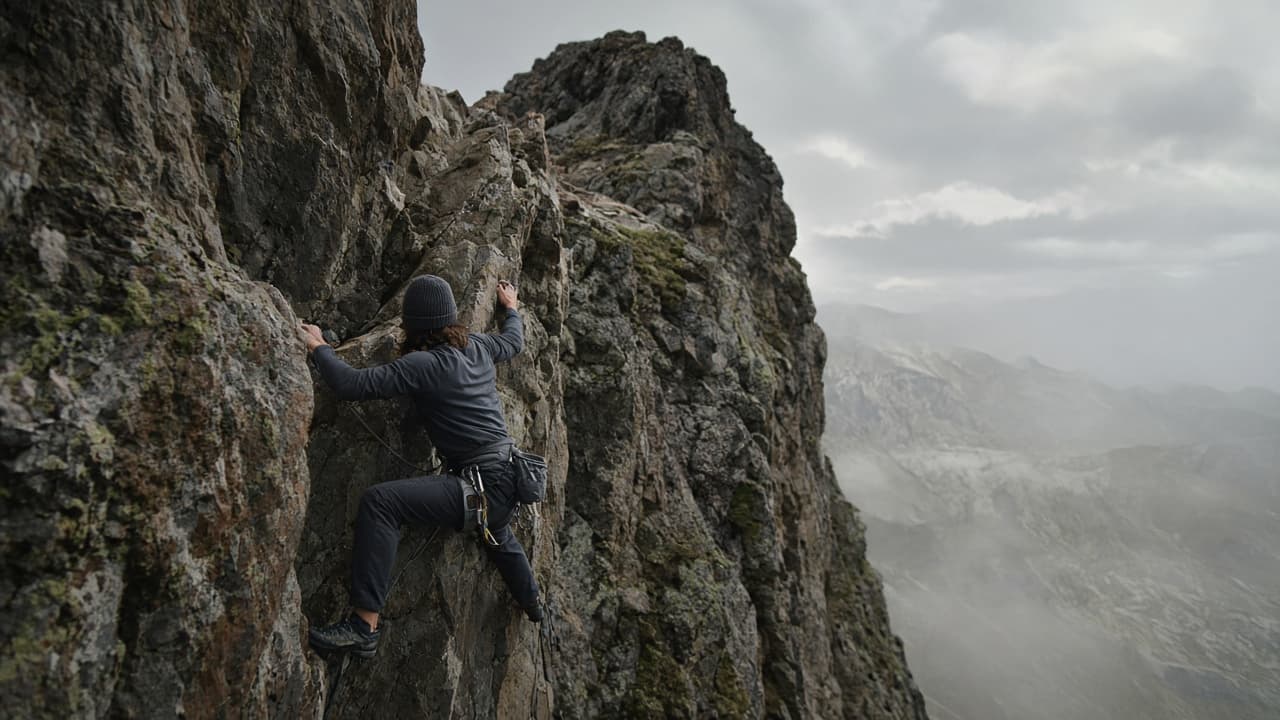
Hold after hold. A pitch. A slope that does not end quickly. You are tired and you are higher than you were.
This is the basic climbing dream: effort that accumulates. It maps onto any project that cannot be done in one gesture, qualifications, sobriety, a book, a slow repair of trust. The body is the ledger.
If the rock was sound and the holds were there, you currently believe the route exists even when it hurts. If you had to make holds, inventing a path, you are pioneering, which is lonelier. Other climbers on the same face make it a cohort; a solo face is a private bill. Resting on a ledge without shame is a skill. Refusing to rest is a culture of ascent that will eventually bill you as a slip.
Slipping, Losing a Hold, Sliding Back
A foot goes. Packed effort undoes. You hear the slide. You may catch a lower hold. You may not.
Slips are setbacks in a long effort, not random falls from a cliff you were standing still on. You had already paid. That is why they sting. Job, recovery, reputation, a conversation that had been going well.
Catching yourself is resilience you already use. Not catching yourself and surviving lower down is a demotion that did not end the climb. Falling all the way is a fear that one mistake zeros the account; sometimes the waking system is actually that punitive, and the dream is accurate about the institution rather than about you. Gear failing, a rope, a carabiner, is trust in support structures: mentors, policies, a partner on belay. If nobody was belaying, you already knew you were uninsured.
The Summit, the Roof, the Window
Arrival. Wind. A view. Sometimes a locked hatch. Sometimes another peak.
Summits are what effort was for. The feeling on arrival is the reading. Satisfaction is rare and worth keeping. Emptiness is the classic: you spent the climb and the top is a fact without a life. Exposure, nowhere to hide, is success as visibility. A further peak is the next demand; some cultures of work never let a top be a top.
A roof of a house is a domestic summit: overview of private life, or a repair job. A window you climbed to is entry rather than overview, you wanted in, not up. Standing on a summit and not knowing how to get down is a real climbers' problem and a good metaphor: ascent skills are not descent skills. Promotions, fame-adjacent moments, and recoveries all have this.
Getting Stuck, Unable to Go Up or Down
Holds run out. Legs shake. Retreat looks worse than the next move you cannot see.
Stuck is a particular misery of climbing, different from not having started. You are already committed to height and the next move is not available. Mid-career. Mid-renovation. Mid-argument. Mid-mountain. The dream often includes the knowledge that hanging on is also a finite resource.
Calling for help is a different scene from silent stuckness. Help that arrives is a belay you were too proud to ask for in daylight. Help that does not is an accurate picture of a system with no rescue. Climbing down a little to go up another line is a strategy dream: you may need to lose height to get a route. People who will not downclimb in the dream often will not in life either.
Have a Climbing dream of your own?
Write what you remember and get a clear reading.
Climbing a Tree, a Wall, a Building
Bark, brick, glass, ivy. The object was not necessarily a mountain.
Trees are living routes: family, a particular life, childhood skill. Climbing one can be play, a lookout, a return to a younger competence. A tree that will not bear you is a living thing you are using as infrastructure; it may not agree. Walls are obstacles that you have decided to treat as routes, a boundary you are going over rather than through. That can be ingenuity or trespass.
Buildings, especially houses and offices, make the climb social and architectural. A drainpipe to a lover's window is desire as burglary. A glass office tower is status with poor holds, you can see the rooms and cannot easily be in them. Climbing the outside of a place you are allowed to enter by the door is a dream about refusing official access, or about official access not actually working.
Climbing Something That Should Not Be Climbed
A person. A moving train. A bookcase. An animal. A sheer pane. The wrongness is the point.
Illicit or absurd objects mean effort applied to a non-route. Climbing a person is using them as infrastructure, status, parents, a partner's body as a way up. Climbing a moving object is trying to ascend while the base is leaving; some jobs and some relationships are that. A bookcase that falls is knowledge or display that will not take your weight.
The dream is often comic until the slip. Take the comedy seriously. You may already know, in daylight, that this is not how one gets where you want. The night puts you on the thing anyway so you can feel the physics. Coming down of your own accord is a good ending. Defending the climb to onlookers is a worse one: you are still selling a bad route.
Climbing Down, or Refusing to Climb
Descent as a choice. Or a mountain, a ladder, a wall you will not start.
Downclimbing is a skill and a decision: leave a height you have, on purpose. It maps onto stepping back from a role, a conflict, a peak that is not worth the weather. Shame about going down is cultural; the dream may be trying to make descent feel like competence.
Refusing to start is the other agency. Not every face is yours. Peer pressure at the base, a group already high, a family of climbers, a company that only respects ascent, is the usual antagonist. Walking away from a mountain along a road is not failure in this scene. It is route choice. If you refused and then envied the view, you still want height; you just will not pay this particular bill. That is a usable split.
Psychological Meaning
Climbing is effort plus memory: you need the last hold to still be true. Robert Stickgold's research on sleep and memory consolidation (including his 2001 work with colleagues on how sleep supports learning and the integration of new experience) offers a grounded frame. Overnight processing helps the brain keep what matters from the day's efforts and feel its way through emotional residue. A climbing dream is a natural theatre for that: the day involved striving, rank, a problem that only yields to repeated small moves, and the night restages the physics.
You do not need a lab to apply it. If you learned something hard, trained, applied, argued uphill, the dreaming system has holds to work with. Stickgold's broader point, sleep is not empty time, argues against treating the dream as a fortune. It is more like extra practice on the feeling of the effort, including the slip you are afraid will wipe the learning.
Climbing dreams do not assign a summit date. They report how the effort currently feels in the body: funded, slipping, stuck, trespassing, or ready to come down.
When Climbing Dreams Keep Returning
Repeating slips usually mean a support or a skill is still unreliable; name it in daylight. Repeating stuckness usually means the next move has not been found, which may require downclimbing a little, not more grit. Repeating illicit objects usually mean you already know the route is wrong and have not authorised yourself to leave it.
If you climb in waking life, subtract some literal replay and still keep the feeling. If you do not, the verb is the subject: effortful ascent. One practical courtesy to the night: rest on an actual ledge this week. The dreaming body is tired of being the only one who is allowed to sit down.