Quick Answer
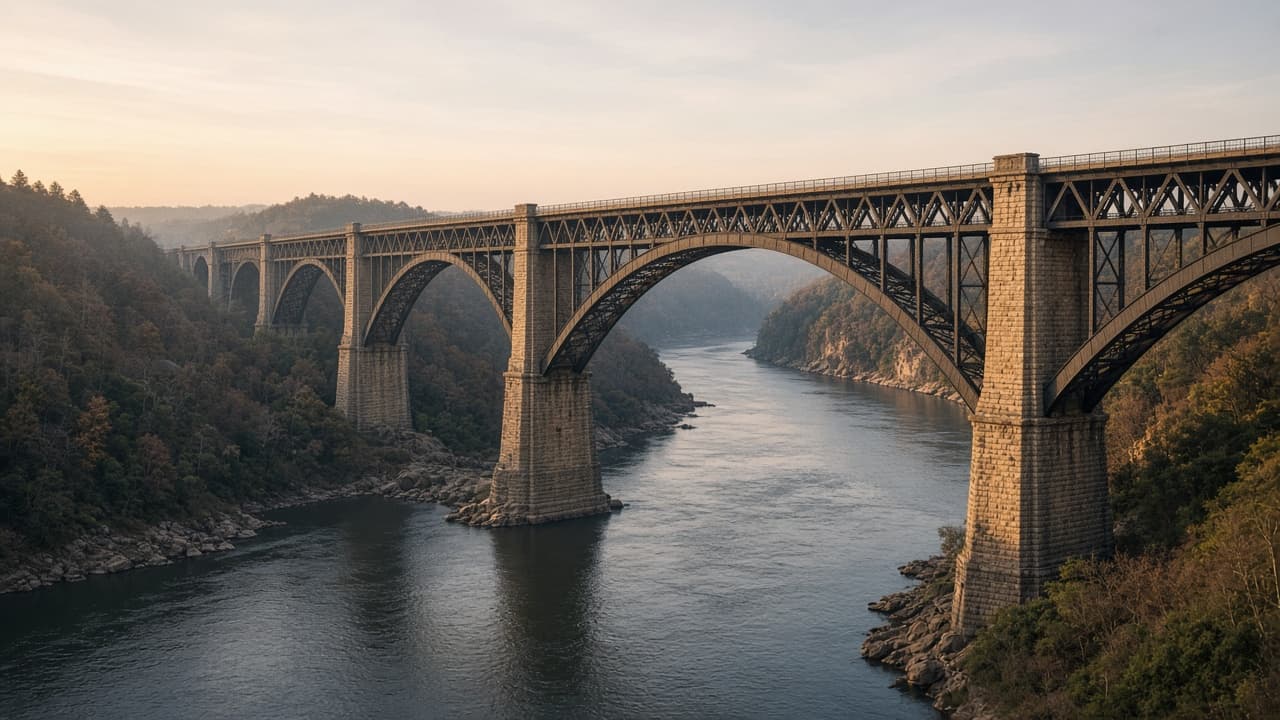
A bridge exists to connect two sides that water, a drop, or a road would otherwise keep apart. Dreaming of one is almost always about a crossing: a decision, a move, a reconciliation, a career jump. The architecture tells you the quality of that crossing, finished or not, burning, too high, packed with [trains](/dreams/trains), swaying. Unlike a [door](/dreams/doors), which is a threshold you can stand in, a bridge commits you to air and distance. Unlike a [tunnel](/dreams/tunnels), you can see how far there is to fall. Recover which bank you left, which bank you wanted, and what the span was made of.
Crossing a Bridge Successfully
You start on one side and you finish on the other. Wind, traffic, and height may be present, but the structure holds. You look back or you do not.
Completed crossings are reports of a transition that is, in fact, happening. The dream may arrive the week you actually do the hard thing, or the week your body finally believes it. Dreamers often underplay these because they are not frightening. They are still data: your mind is marking a bank change.
If the far side was unexpected, a different city, a childhood home, a blank field, you may not know what the decision is for, only that you are doing it. If someone waited on the far side, name them. That person is often the reason the bridge exists.
An Unfinished or Broken Span
Planks missing. Rebar in air. A gap you would have to jump. The other side is visible and mocking.
Unfinished bridges are desired crossings that do not yet have infrastructure. You can see the job, the country, the relationship phase, the sobriety, the degree. The path has not been built. This is different from a locked door: the problem is not permission so much as construction.
Who was building it matters. If workers were present, you may be waiting on other people to finish a process. If you were expected to jump the gap, the dream is asking for a leap the structure cannot honestly support yet, a useful warning. Standing at the broken edge and turning back is not cowardice in this scene; it is an accurate engineering assessment.
A Bridge Burning Behind You
Flames on the deck you just left. Smoke. No return. Sometimes you lit it. Sometimes it caught on its own.
This is irreversibility, using a metaphor English already owns. Resignations, ultimatums, public statements, deletions, a move that sells the house. The old bank is not available, which is the point of the fire and also the cost.
If you set the fire, you wanted the option removed, often because you did not trust yourself not to go back. If the fire started without you, the waking analogue may be someone else's decision, or a consequence that moved faster than your plan. Heat on your heels while you are still mid-span is the worst version: committed, not arrived, and the past already gone.
Do not read burning as moral failure. Read it as a report on whether return is still possible, and whether you wanted it to be.
Height, Water, and the Drop
The span is high. Below is a river, a lake, a motorway. Your hands on the rail. Vertigo. Sometimes you fall.
Height over water combines two threat images: the drop of falling off a cliff and the engulfment of drowning. The dream is rarely about bridges as civic engineering. It is about a crossing whose failure-mode would be both a fall and a going-under, humiliation plus loss of the life you had.
Clinging to the rail is a different dream from walking in the middle of the lane. Clinging means you are making the crossing while managing panic in real time. Walking freely at height more often means the risk is real and you have enough trust in the structure to use it.
If you jumped rather than fell, treat that as a choice scene, closer to commitment than to accident. If you were pushed, name who pushed.
Have a Bridges dream of your own?
Write what you remember and get a clear reading.
A Bridge Packed with Traffic or a Crowd
You cannot go at your own pace. Cars, a march, a crush of people. The span is a shared bottleneck.
Crowded bridges are crossings that are not private. Industry layoffs, migration routes, graduation years, a family in which everyone is divorcing at once. You want to get to the other bank and so does a population. The stress is congestion and comparison, not solitude at height.
If you were carried by the crowd, you may be making a change because the cohort is making it. If you were stuck while others streamed past, the dream is about being slower than the group you thought you belonged to. A train on the bridge adds institutional timing: the crossing runs on a timetable you do not set.
Being Stuck in the Middle
Neither bank is available. Fog. A toll you cannot pay. The bridge has become a residence.
Mid-span life is a recognised misery: the long notice period, the separated-but-not-divorced year, the visa in process, the house sale that will not complete. You have left and you have not arrived. Dreaming simply builds a place for that fact.
Fog on the bridge usually means you cannot currently see either old life or new life clearly. A toll or checkpoint mid-span points at a cost that revealed itself after you started. If you lived on the bridge, a shack, a camp, the transitory state has lasted long enough to grow furniture. That is worth taking as a prompt to name an end date, even a provisional one.
A Bridge You Are Afraid to Step Onto
The structure looks fine from the bank. Your body will not start. Other people cross. You stay.
Refusal is still a bridge dream. The crossing exists; you do not consent yet. It clusters around opportunities that are real and expensive, a job in another city, a conversation that would change a marriage, a medical procedure, telling a family a truth.
Looking down is often the tell. You are not evaluating the destination; you are evaluating the failure-mode. That can be wisdom. It can also be a stall dressed as prudence. The dream will not tell you which. Your week will: have you gathered the information the crossing actually requires, or are you researching the drop because researching the far bank would make the decision due?
Psychological Meaning
Bridges are what Ernest Hartmann called a contextualizing image: a picture that pulls several feelings into one place. In Dreams and Nightmares (1998), Hartmann argued that dreaming weaves new emotional experience into existing memory using a central image whose features match the feeling's shape. A bridge is almost too apt, connection, risk, height, water, irreversibility if it burns. When your waking life is about getting from one condition to another with a drop in between, the sleeping mind does not need to invent an abstract symbol. It can use a bridge.
That is why these dreams feel obvious after you name the banks. The image is not hiding the problem. It is concentrating it. Hartmann's view also predicts that the more intense the emotion, the more powerful and bizarre the image can become, a burning, endless, or collapsing span rather than a quiet footbridge.
Do not treat the dream as a command to cross or a warning never to cross. Treat it as a model of the crossing as you currently feel it: unfinished, crowded, burning, high, or simply walkable. Then do the waking engineering.
When Bridge Dreams Keep Returning
A repeating unfinished span usually means the infrastructure is still missing; build or wait, but stop pretending you can walk air. A repeating burn usually means you are still arguing with irreversibility. A repeating drop means the failure-mode has not been planned for.
Walk the real decision in daylight in three sentences: what I would leave, what I would reach, what would have to be true of the span. If you cannot fill the third sentence, the dream is doing unpaid project-management. If the dreams are panics at height and you also have waking vertigo or a recent fall, include the body in the reading. Not every high bridge is a metaphor.