Quick Answer
The [cheating](/dreams/cheating) hub covers both directions. This page is only one: you are the person who finds out. Discovery, evidence, and confrontation are the plot engine. The dream is almost always about the security of the attachment, or about a [betrayal](/dreams/betrayal) that is not sexual at all, rather than about their secret diary. A dream cannot observe a room you are not in. Treat anything that felt like "proof" as a feeling that wants an answer, not as a file you were sent.
Catching Them | a Door, a Street, a Room You Know
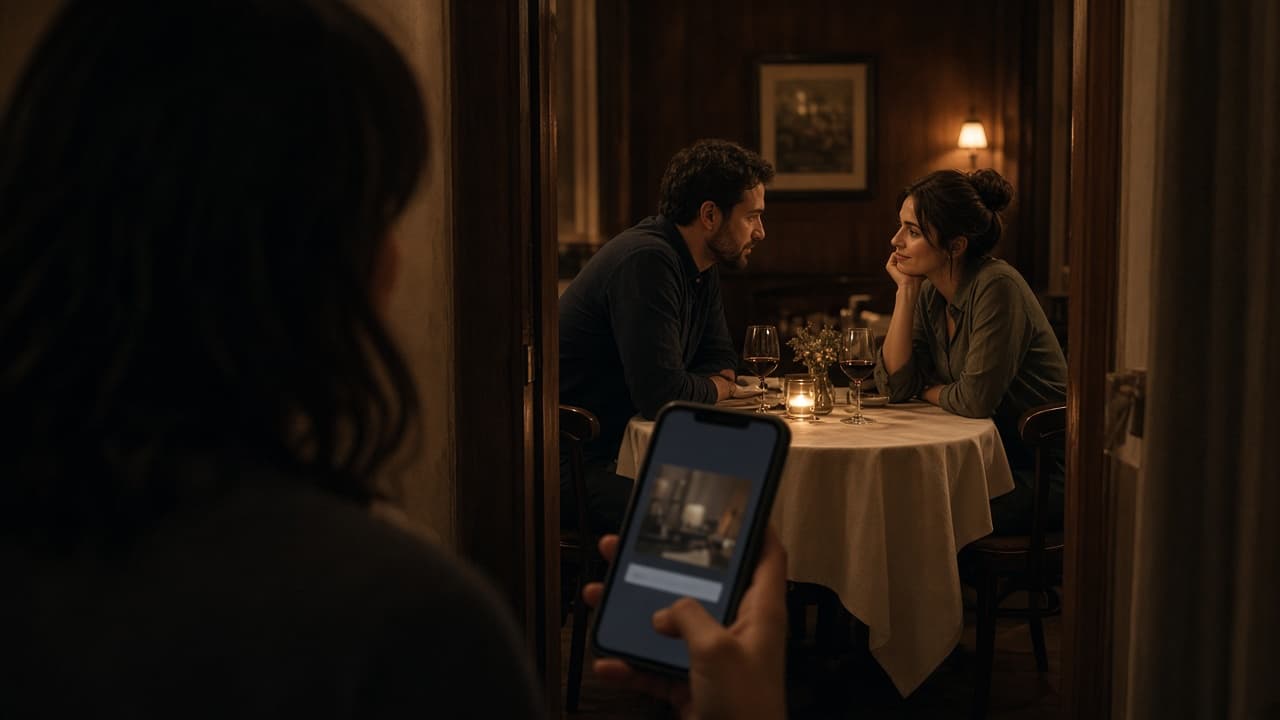
The cinematic discovery. You arrive. The scene is already running.
Arrival dreams emphasise the late-to-the-information position. They cluster during long-distance stretches, new friend groups you are not in, jobs that eat the evenings, and the weeks after any real breach of trust, even a small one. Dreamers remember the doorway more than the bodies, which is useful and keeps the reading non-graphic: the threshold is the symbol. You were outside. Then you were not.
If the room was your actual bedroom, the violation is territorial as well as romantic. If it was a place you have never been, the affair is more metaphorical, a life they have that you do not share.
Evidence Without a Scene: Phones, Receipts, a Look
No sex in the plot. A screen at the wrong angle. A hotel charge. A pause before they pick up.
Evidence dreams are suspicion's workshop. The mind loves forensic props because they feel adult and fair, unlike "I just feel it." In waking life, people in anxious attachments collect similar props (tone of voice, last-seen times). The dream is showing you the collecting, which is often the problem as much as the fear.
A look that "proved it" with no object is pure interpretation. You are already living in a story. The night made the story visible.
Confrontation | You Speak, They Deny, They Confess, They Shrug
The conversation the discovery dreams often skip, and this page does not.
What they did with your words is the attachment report. Denial that made you smaller maps onto not being believed in the relationship generally. A shrug is contempt or exhaustion. A confession that felt like relief can be a wish for the anxiety to end in either direction, even a bad truth would be a floor.
If you could not speak, compare mute dreams elsewhere: the freeze is the cost of being the "cool" partner. Many people would rather be betrayed in a dream than be seen as jealous in the morning. That preference has a price.
The Third Person Is Someone You Know
A friend, a colleague, a sibling, an ex-partner. The cast is not random.
Known thirds are usually chosen for a quality: access to their time, a trait you fear you lack, a history. The dream is rarely a tip about that person's plans. It is a map of where you think the threat lives. Dreamers who then treat the friend differently in daylight are letting the night direct a waking relationship. That is allowed as a feeling (I felt threatened) and messy as a prosecution.
If the third was a stranger with one exaggerated trait (younger, richer, kinder), the trait is the rival, not a secret name you should hunt.
Have a Being Cheated On dream of your own?
Write what you remember and get a clear reading.
You Are Not Even in a Relationship, and Still This Plot
Single, divorced, or months out, and the dream casts a specific person as unfaithful to you.
Unattached betrayal dreams reuse an old template. They follow new dating, a crush who is inconsistent, or a friendship that has a couple-shaped hole. They also follow divorce residue: the nervous system still runs the old drill. The person in the dream may be a recent date who did not text, inflated into an affair because affairs are the sharpest picture of not being chosen.
You do not need a partner for this dream to make sense. You need a wish to be chosen and a fear that you will not be.
The Betrayal Is Not Sexual | They Chose a Life, a Job, a Secret
A variant people under-report because they searched the sexual phrase.
Non-sexual cheating dreams (they moved countries, they had another family in the bureaucratic sense, they gave your shared future to a project) are still being-cheated-on dreams. The structure is exclusion from a we. Dreamers wake less jealous and more grief-struck. That grief is often closer to the waking issue than a bedroom scene would have been.
If you felt foolish rather than furious, the live current may be status: being the last to know about a decision that affected you.
You Forgive Them in the Dream, or You Leave on the Spot
The ending you are rehearsing.
Instant leaving is a wish for a clean spine. Instant forgiveness is a wish for the alarm to stop without a fight. Neither is an instruction. Dreamers who leave and then wake in a good relationship are not being told to pack. They are practising the existence of an exit, which attachment research would call a protest behaviour in fantasy form.
If you bargained (stop seeing them and I will not leave), you already know the deal you are afraid of offering.
Psychological Meaning
Michael Schredl's diary studies of dreams about romantic partners (including Schredl, Desch, Röming and Spachmann, 2009, on erotic dreams and waking sexuality in International Journal of Dream Research) show that partner-dream frequency tracks preoccupation and relationship quality, not a private surveillance channel. Insecurity writes more episodes. The night is a diary of how occupied you are.
G. William Domhoff's continuity hypothesis explains the props and the cast: the people and devices of your actual bond show up because they occupy you. Handle the morning on purpose, name the feeling, ask for the reassurance you actually want, because a betrayal dream can change how you treat someone at breakfast without having revealed a crime.
Freud's wish that you secretly want the drama is a poor default for the betrayed-person dream. Most dreamers would pay to not have had the night. The wish, if any, is usually for certainty.
If the evidence-object, the doorway, or the confrontation-style is the part that lasted past coffee, put those three into a personal reading in thirty seconds. Leave their actual fidelity in the waking world, where evidence has to be evidence. The dream is a question about whether you feel chosen. That question is allowed. The dream is not the answer.