Quick Answer
An airplane is a vehicle for distance. Unlike [cars](/dreams/cars) or even [trains](/dreams/trains), you cannot easily stop, turn around, or get out between stations. That constraint is the meaning. Airplane dreams cluster around long-range transitions, emigration, a career leap, a relationship that relocates your whole life, and around the specific moments that make those transitions feel irreversible: takeoff, turbulence, the gate closing, a landing you cannot see. If you fly often in waking life, subtract some of the anxiety; the dream may be replaying a trip. If you rarely fly, take the metaphor more seriously.
Taking Off
The ground drops. The city becomes a map. Your stomach registers the angle. Sometimes the takeoff is thrilling; sometimes it is a mistake you cannot undo.
Takeoff dreams mark the moment of commitment to a long-range change. Notices have been handed in. Tickets bought. A conversation has happened after which you cannot return to the previous smallness. The runway is the last local stretch.
If the plane struggled to lift, the waking analogue is often insufficient thrust: not enough money, not enough support, a plan that looked fine on paper. If takeoff was smooth and you still felt grief, you may be mourning the ground, the version of life that cannot come with you, rather than fearing the air.
A takeoff you watched from the ground, rather than sat inside, is a different dream: someone else's transition, or a departure you did not board.
Missing the Flight
Security lines, a gate that has closed, a passport that will not appear, a late taxi. The airplane is still there and then it is not. The destination continues without you.
This is one of the most reported travel-anxiety scenes, and it is usually about access to a one-shot change rather than about punctuality in general. Flights leave. Meetings can theoretically be rescheduled; many life-gates cannot. Dreamers describe this around visa windows, application deadlines, fertility timelines, and the sense that a version of themselves is departing whether they pack or not.
What blocked you is the reading. Lost documents point at missing credentials or identity paperwork in the metaphorical sense, you do not yet have the status the next life requires. A companion who delayed you points at a relationship pulling against the departure. Simply not hearing the announcement is often about information: you did not know the real time.
If you made a later flight, the dream is usually less catastrophic than it felt. A second chance existed. If the airport emptied and no other planes came, you currently believe this was the only departure.
Turbulence Mid-Flight
The cabin shakes. Trays jump. You look at the wings. Nobody can get off. The journey continues through weather you did not choose.
Turbulence is the messy middle of a transition already in motion. You have left, you have not arrived, and the path is not smooth. It maps onto the months after a move, after a merger at work, after a diagnosis, after a yes that turned out to include weather.
Seatbelt signs and crew behaviour are useful. Calm crew in a shaking cabin often means you have some trust in the process even while your body does not. Panic spreading through the cabin more often tracks social contagion: everyone in your life is also scared about the same change.
Unlike falling off a cliff, turbulence includes a container. You are still in a machine designed for this. That distinction is worth keeping when you wake up terrified.
Piloting the Plane
You are in the cockpit. Instruments glow. You may know what they mean or you may be guessing. Passengers may be behind you.
Piloting is responsibility for other people's long-range outcome as well as your own. Parents, founders, team leads, and eldest siblings report this more than they report passenger dreams. The question is competence.
If you could fly, even roughly, the dream often accompanies a stretch where you have actually been the operator, making the calls, holding the course. If you were in the seat with no training, you are being asked to operate a transition you were not prepared for. Autopilot that failed is a specific variant: a system you relied on, a partner, a process, a senior person, has stopped carrying the flight.
Landing the plane yourself, however bumpily, tends to be a mastery dream. Crashing from the cockpit is a fear-of-responsibility dream, not a forecast.
Have a Airplanes dream of your own?
Write what you remember and get a clear reading.
A Plane Crash or Emergency Landing
Impact, fire, water, a field. Survival is uncertain. Sometimes you walk away. Sometimes the dream ends at the drop.
Crash imagery is the failure-mode of a high-stakes transition. It is not a prediction of an accident, and treating it as one only adds a second fear. It shows up when the change is large enough that a bad outcome would be life-altering: a company, a crossing, a medical procedure framed as a journey.
Emergency landings are importantly different from total wrecks. An emergency landing means the transition aborted into an unplanned but possibly survivable place. Dreamers report this around jobs that ended early, moves that reversed, relationships that did not complete the arc. Walking away from a wreck more often tracks: the plan failed and you are still here, which the dreaming mind is trying to make real.
If you were watching the crash from the ground, ask whose project you think is going down.
Being on a Plane That Will Not Land
Hour after hour. Fuel unknown. The destination keeps receding. You walk the aisle looking for an ending that does not come.
This is a dream about a transition with no arrival. Consulting life, long-distance relationships, chronic treatment, a visa in process for years. The airplane was supposed to be a journey with a gate at the other end. Instead it has become a condition.
Fellow passengers matter. If they were calm, you may be the only one still expecting an airport. If they were also desperate, the group you are in is collectively stuck in transit. Wanting to jump is a different scene, closer to preferring a cliff to an endless cabin, and should be read as protest against duration, not as a wish to die.
Airports, Gates, and Waiting to Board
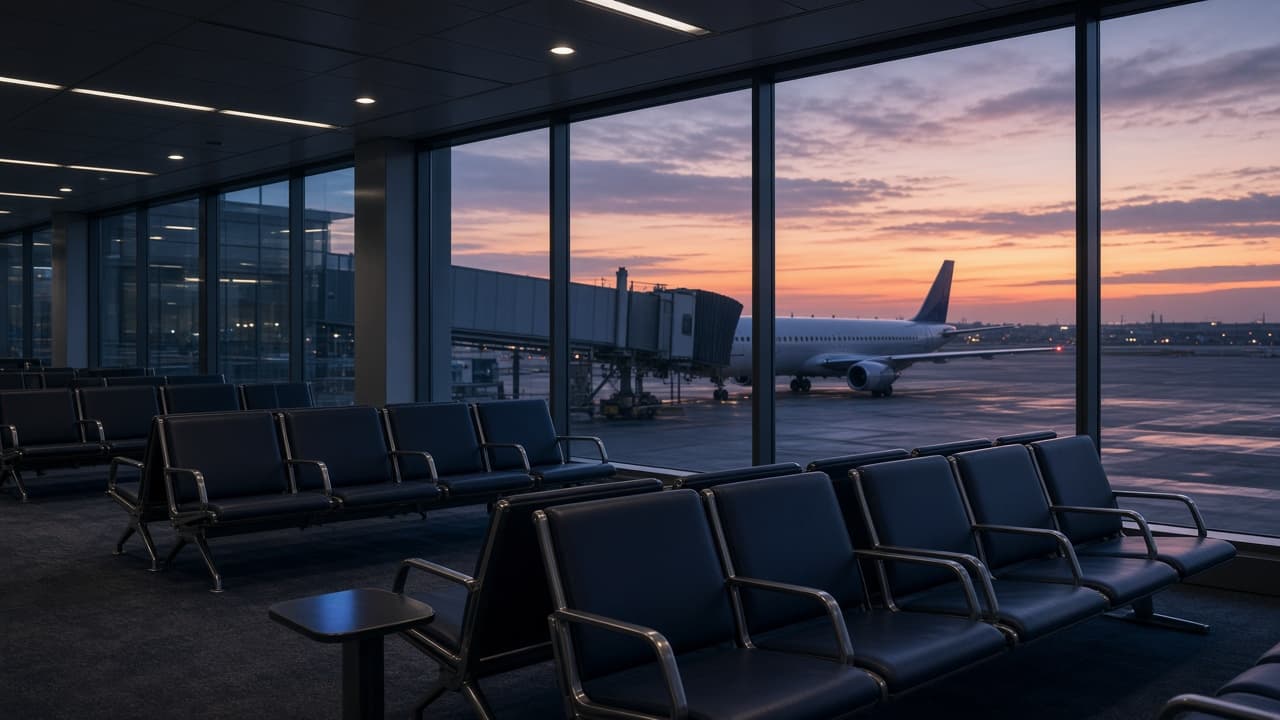
You have not flown yet. You are in the liminal building: queues, boards, zones, a gate that keeps changing. Ships have docks; planes have this particular purgatory.
Airport dreams are about authorisation. You are near the long-range change but not on it. Security, passports, and boarding groups all picture systems that decide whether you belong on the next life. They cluster around applications, interviews, medical clearances, and any process where someone else scans you before you may proceed.
A cancelled flight on the board is not the same as missing one. Cancellation is an external no. Missing is a you-and-the-clock problem. If the destination on the board kept changing, you may not actually know where the transition is supposed to take you, which is worth admitting in daylight.
Security that will not clear you is a particular humiliation: shoes off, laptop out, a body that has become a problem for a scanner. Dreamers report it around visa interviews, HR processes, and any week when they feel suspected without a charge. A wrong terminal, or a gate that moves while you walk, is orientation failure inside a building that pretends to be a map. You are in the right city of change and the wrong wing. Ask which waking process keeps relocating the door.
If the whole night was the airport and never the plane, stay with this section. If you then missed the flight, that page owns the clock.
Psychological Meaning
Air travel is a modern typical-dream setting because it concentrates irreversibility, bureaucracy, and height. Rosalind Cartwright argued in The Twenty-four Hour Mind (2010) that dreaming is overnight emotion regulation: the sleeping brain reprocesses emotionally hot material so it can be stored as memory rather than as raw charge. Airplane dreams fit that job description cleanly. A looming move, a job on another coast, a fear of catastrophe in a sealed tube, these are high-arousal problems. The dream runs the takeoff, the missed gate, the shake, the imagined wreck, and by morning the feeling is often slightly more usable.
Cartwright's frame also explains why crash dreams are poor fortune-tellers and good thermometers. The brain is not informing you of a future accident. It is down-regulating the fear that a high-stakes plan could fail, using the most available disaster movie for that kind of plan.
Use the dream as a map of which phase you are in: still in the airport, already airborne, shaking, or imagining the wreck. Then match it to the real transition. The useful work is almost never "avoid flying." It is "name the gate, the thrust, or the weather."
When Airplane Dreams Keep Returning
Repeating missed-flight dreams usually mean a window is still open and still frightening. Repeating turbulence usually means you are in the middle and looking for a seatbelt. Repeating crashes mean the failure-mode has not been talked through; a daylight conversation about what you would do if the plan failed often steals the dream's job.
If you have a real trip coming up and you are an anxious flyer, some of this is rehearsal of the trip itself. Pack, sleep, use the techniques you already know for flight anxiety. If there is no trip and the plane keeps leaving without you, look at the life-gate, not the sky.